


 1. SAN FRANCISCO GARTER SNAKE
Not Dangerous (Non-poisonous) – This snake does not have venom that is dangerous to most humans.
Gartersnakes have toxins in their saliva which can be deadly to their prey and their bite might produce an unpleasant reaction in humans, but they are not considered dangerous to humans.
Often escapes into water when threatened. When first handled, typical of gartersnakes, this snake often releases cloacal contents and musk, and strikes.
This snake also utilizes a wide variety of habitats, preferring grasslands or wetlands near ponds, marshes and sloughs. May overwinter in upland areas away from water.
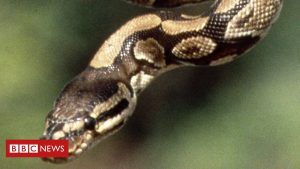
2. BRAZILIAN RAINBOW BOA
The Brazilian rainbow boa is the largest of the several recognized rainbow boa subspecies (up to 12) endemic to Central and South America.
These beautiful snakes are found in the Amazon basin of Brazil, Southern Venezuela, French Guiana, coastal Guyana and Suriname.
Rainbow boas are members of the Boidae family, which includes about 40 other species like the
boa constrictor or the Amazon rainforest giant snake the green anaconda . All boas are considered primitive snakes, because they still display vestigial hind limbs as small spurs on both sides of the cloaca.
These primarily terrestrial snakes are usually found near water, they inhabit rainforest, humid woodland forests but can also sometimes be found in open savannas. They do have a prehensile tail to help them climb, but they are not truly arboreal snakes.
The Brazilian rainbow boa is a medium size species, with a round body boa ranging in length from 4 to 6 feet (1.2 – 1.8 m) and weighing 2 or 3 lbs. Females grow larger than their male counterparts. Although not especially large their head is distinctly wider than the neck with 3 parallel black stripes.
There is a great variation in both color and pattern among these snakes. They have a soft and beautiful iridescent skin, hence their common name, rainbow boas. Just after shedding its scales become even more iridescent. The Brazilian rainbow boa is brown or reddish-brown, with large black dorsal blotches down the back.
They are considered by many as the world’s most beautiful snake, although I would consider one other species a real contender for this title the green tree Python or even the emerald tree boa.
The species is also known as the slender boa or simply rainbow boa.
Because of their beautiful iridescent skin, the Brazilian rainbow boa is a very popular species within the exotic pet trade. Since this species needs a high humidity environment, they are regarded as an intermediate or difficult snake to keep in captivity.
These boas are readily available at exotic pet stores, or local reptile shows with several morphs available. When they are younger they are more prone to bite due to natural defense instincts, but as they become more used to handling tend to calm down.
Like other species, the young Brazilian rainbow boas are probably preyed upon by birds of prey, small mammals or other reptiles. Their lifespan in the wild is estimated to be around 10 years, but in captivity, the species may live up to 30 years.
3. HONDURAN MILK SNAKE
Called milk snakes due to the fable that they milk cows, Honduran milk snakes, are secretive and powerful constrictors that can attain a length of up to four feet. They are primarily terrestrial and are nervous creatures that can be difficult to handle.
Hatchlings can be feisty, striking and biting when only minimally provoked. Adults are usually less apt to bite, but often squirm strongly and void the contents of their cloaca when restrained. Despite those drawbacks, the Honduran milk snake’s brilliant coloration, ready availability and very wide range of costs, make this hardy snake a hobbyist favorite.
Honduran milksnakes are large and powerful, well designed for a life burrowing through leaf litter and loose soil. These characteristics also make them uniquely suited for escaping from cages, so regardless of the type of caging chosen, it must be absolutely secure! Like other members of the genus Lampropeltis, Hondurans are ophiophagus, meaning they will eat other snakes, including members of their own species. Therefore they should be maintained singly.
4. FORMOSAN ODD SCALED SNAKE
Small snake; total length up to 90 cm. Whole body is iridescent under light. There are 23-29 (mostly 27 at mid-body) rows of scales, which are keeled throughout body (and tail). The scales of an outermost row in upper face of postcloacal region are not much enlarged when compared with adjacent scales. Head is small, oval and not distinct from neck; body is slender; tail is moderately short. Eye is small, bead-like; iris is black, indistinct since it blends with dark head and pupil is round, black, and blends with rest of eye. Tongue has reddish stem and diffuse gray fork tips whose base is dark brown. The frontal is slightly broader than long; the parietal is nearly twice as long as broad and contacted posterolaterally by an enlarged paraparietal scale.
Upper head, body and tail is uniform olive (dark-edged in anterior part of scale), grayish tan, or black. There is a dark longitudinal line on mid-dorsal row of scales on body and tail. Ventral surface is olive-yellow (dark-edged in anterior part of scale) or dark gray; the color is slightly darker on tail than on body. Whole body is usually black in the young. Anal scale is entire, and subcaudals are not divided.
Biology & Ecology This nocturnal and terrestrial oviparous snake inhabits humid environments, such as montane forest floors, stone cracks or decayed plants. Earthworms, slugs, or frogs may be its staple food. It is not aggressive, and reports of attacks by this snake are rare.
5. RED HEADED KRAIT
Kraits are a genus of snakes which number among the world’s deadliest in terms of the quantity of venom needed to kill a human. There are fourteen species of krait, found in South East Asia and in South Asia. The feed on other snakes, including members of their own species.
Three species of krait are known from Sumatra. These are Bungarus candidus, the Malayan krait or blue krait, Bungarus flaviceps, the red-headed krait, and Bungarus fasciatus, the banded krait.
Kraits are nocturnal, feeding at night and in the early morning. Untreated krait bites are usually deadly, however bites by the red-headed krait are rare to unknown. The Malayan krait and banded krait are dangerous at night, when they are far more likely to strike.
6. IRIDESCENT SHIELDTAIL
Shieldtail snake , (family Uropeltidae), any of 45 species of primitive burrowing snakes
endemic to southern India and Sri Lanka . There are eight genera of shieldtail snakes. Of the 30 Indian species, 18 are members of the genus Uropeltis , and of the 15 species found in Sri Lanka, 8 are members of the genus Rhinophis. Shieldtail snakes are small, typically growing to between 25 and 50 cm (10 and 20 inches) in length—although some may grow to 90 cm (35 inches). They are harmless, specialized snakes that have narrow, pointed heads with tiny eyes beneath head shields. Shieldtails are named for their unique tails, which are heavily keeled and terminate in disklike shields or multiple spines in most species. Most species appear black, purple, or brown, but some are coloured with red, orange, or yellow spots and bars; all are highly iridescent.
Shieldtails are nocturnal and live at higher elevations in loose soil, among plant roots , under decaying vegetation, and in agricultural beds. They dig their own tunnels, which are plugged by their disked tails that provide a purchase when tunneling. This practice prevents other predatory snakes from attacking them from behind. When they are handled, their defensive behaviour is defecation . Their diet is principally made up of earthworms ; however, some species also consume
arthropods . Shieldtails are completely inoffensive and never bite. They give birth to 3–9 living young.
7. GREEN TREE PYTHON
The Green Tree Python (Morelia viridis ) is an arboreal species which spends a great deal of its time in trees, as its common name suggests.
Adult Green Tree Pythons are bright green in colour with a broken vertebral stripe of white or yellow. They may also have blue, white or yellow spots scattered over their body, their colour patterns varying according to their different locations. They can reach lengths of between 1.2 and 2.2 metres and have a slender shape with a prehensile tail enabling them to hold on to and move easily between tree branches.
Juvenile Green Tree Pythons vary in colour from brick red, orange, yellow, to dark brown-black, all in the same clutch. As they mature at between six and eight months old, they change to the adult bright green colour, but some may take up to two years to make the full change to green. It can be an exciting pastime to watch their colour change as each colour pattern is unique to each individual snake,Behaviour and diet.
Green Tree Pythons are solitary and only descend to the ground to hunt or to move between trees. They have a particular way of curling up on tree branches, in a saddle position placing their head on the middle of their coils. This trait and their physical appearance are similar to the Emerald Tree Boa ( Corallus caninus ) of South America, which causes people to confuse the two, especially when seen outside their natural habitat.
The large head of the species is wider than the body and has thermo-receptive pits in the scales around the mouth which detect relative changes in temperature. These thermo-receptive pits help the snake detect warm-blooded prey when hunting at night when they are most active. Their diet mainly consists of rodents, rabbits and other small mammals and reptiles.
They use their tails asGreen Tree Pythons are solitary and only descend to the ground to hunt or to move between trees. They have a particular way of curling up on tree branches, in a saddle position placing their head on the middle of their coils. This trait and their physical appearance are similar to the Emerald Tree Boa ( Corallus caninus ) of South America, which causes people to confuse the two, especially when seen outside their natural habitat.
The large head of the species is wider than the body and has thermo-receptive pits in the scales around the mouth which detect relative changes in temperature. These thermo-receptive pits help the snake detect warm-blooded prey when hunting at night when they are most active. Their diet mainly consists of rodents, rabbits and other small mammals and reptiles.
They use their tails as a hunting strategy, attracting prey by wriggling their tail to resemble a worm or small snake to birds and lizards. They grab their prey from a distance. Using their wide jaws and enlarged front teeth to hold on to fast-moving prey, they coil around and suffocate the prey. Another method of capture is by holding onto a branch using their prehensile tail and striking out in an s-shaped position to grab their prey before constricting on a hunting strategy, attracting prey by wriggling their tail to resemble a worm or small snake to birds and lizards. They grab their prey from a distance. Using their wide jaws and enlarged front teeth to hold on to fast-moving prey, they coil around and suffocate the prey. Another method of capture is by holding onto a branch using their prehensile tail and striking out in an s-shaped position to grab their prey before constricting it.
8. EASTERN CORAL SNAKE
The eastern coral snake is found in scattered localities in the southern Coastal Plain from North Carolina to Louisiana, including all of Florida, where they are most prevalent. They can be found in pine and scrub oak sandhills habitats in parts of their range but sometimes inhabit hardwood areas and pine flatwoods that undergo seasonal flooding.
Coral snakes are rarely seen in most areas where they occur, probably because they are highly secretive and spend most of their time underground. They typically do not climb trees or shrubs and spend only limited time crawling above ground. Most sightings of coral snakes are in the spring and fall. When threatened, coral snakes often elevate and curl the tip of their tail. They are noted for preying primarily on other snakes and lizards, which they kill by injecting with venom. Eastern coral snakes lay an average of six or seven eggs in early summer and the young hatch in late summer or early fall. Perhaps because of their secretive habits, coral snakes often persist is suburban areas.
Coral snakes are afforded no federal or state protection, but because of their secretive nature small populations are probably unknowingly destroyed by human development of their habitat.
9. BLUE RACER SNAKE
The Blue Racer ( ) is a subspecies of Coluber constrictor, a group of non-venomous colubrid snakes commonly referred to as the eastern racers.
In the past, there was some controversy about designating the blue racer as a distinct subspecies today it has been accepted as a separate subspecies of the eastern racers.
Their range extends from Canada including eastern regions of Pelee Island to the north and Mexico, Guatemala and, Belize in the south.
This species is also found throughout the US in the eastern regions of the Rocky Mountains in the states of Ohio, Indiana, Michigan, Illinois, Oregon, Wisconsin, Washington, western South Dakota and Iowa.
The blue racer snake can be found in open or semi-open habitats, like hedgerows, meadows, savannas or weedy lake edges and marshes and all these habitats are necessary for fulfilling their ecological requirements.
These snakes are very intolerant to human activity for this reason they prefer to live in areas with fewer human habitations.
Usually, they are among the first snake species to disappear from developing suburban areas. Their habitat can occupy an area extending up to 25 acres, but a large number of them can live in the same area, as the species is not territorial by nature.
As their common name suggests, the blue racer is a very fast snake that can move at speeds of almost 7 Km or 4,3 mph, even so far from the lightning speed of the highly venomous black mamba .
This speed helps them catch prey or avoid being preyed upon. The species lifespan in the wild ranges from 15 to 20 years.
They are active during daytime and prefer to spend most of their time on the ground, but are known to forage both on ground and trees. The blue racers are known to hibernate in large groups during the cold winter months.
When hunting they hold up their heads up and move very fast through brushes using their keen eyesight. The blue racer will try to escape into the bush and may even climb into low bushes or small trees if threatened. Even though they are non-venomous, they are still very capable of inflicting a painful bite if cornered.
Their length ranges between 35 to 60 inches (90 to 152 cm) and it’s one of the largest snakes found in Ontario.
The underbelly color is a creamy white, the backside varies from a brilliant blue (hence their common name) to a dull gray and they have light brown to gray dorsum.
They have smooth scales, large eyes, and a brownish orange snout. Unlike adult blue racers, hatchlings and juvenile snakes display dorsal blotches that will eventually fade away by their 3rd year.
Some of the large birds of prey like the red-tailed hawk, northern harrier, and great horned owl are amongst its predators but they are also preyed on by coyotes, foxes, raccoons, dogs and feral house cats or wild cats.
10. ASIAN VINE SNAKE
Asian vine snake, looks like a long, green vine, just perfect for the swinging, but it’s actually a long, green, venomous SNAKE!
There are 8 species of Asian Vine Snake found in the rainforests of countries like India, Burma and Malaysia.
The biggest species, like Ahaetulla prasina , may reach some 1.8 metres (6 feet) long, while others are just 60 cm (2 ft) in length.
However big they are, they’re always incredibly slender and a lot of them are a beautiful, bright green colour. That’s why they’re called Vine Snakes or Whipsnakes.
Asian Vine Snakes spend their lives up in trees and shrubs, clinging to the branches and mostly not moving much. That way they can remain well camouflaged and watch the world go by with their enormous, unimpressed eyes.
One really cool thing about these snakes is the incredible control they have over their bodies. Have you ever done that exercise where you lay on your back, feet together, lift your heels an inch off the floor and try and stay like that for as long as possible? It quickly becomes agony.
Asian Vine Snakes are quite shy and often don’t even bite. Their venom is quite mild anyway, and seems to cause little more than a bit of swelling in humans. Also they’re rear-fanged. Their fangs aren’t at the front of their mouth like in vipers, but at the back instead.
Regardless, the fangs and venom are sufficient to rapidly paralyse the fast, energetic lizards that make up their diet. One species even clings to a branch overlooking a river and feeds exclusively on fish!
They may look dainty, but they’re still deadly.