

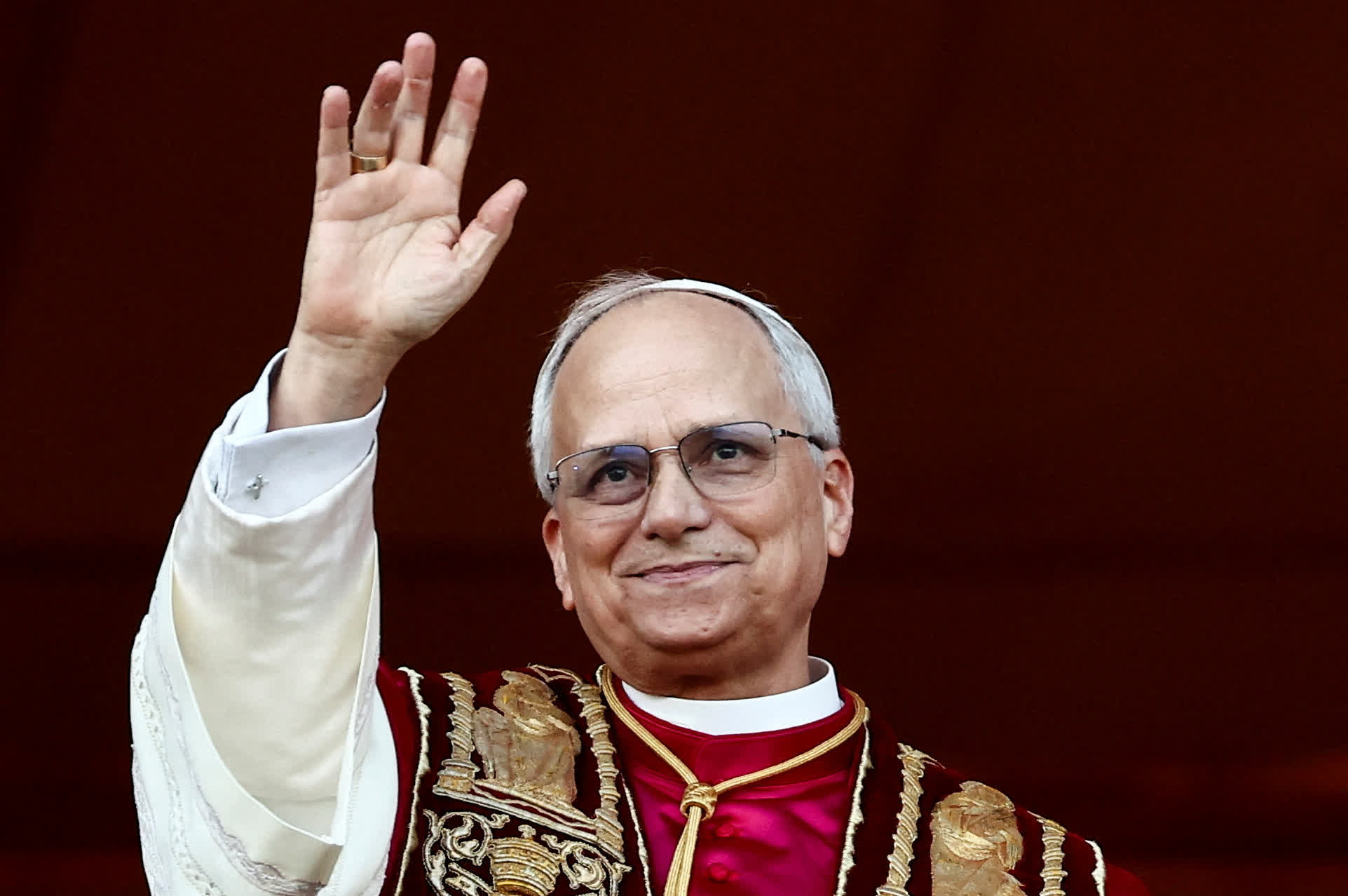
Pope Leo XIV signalled where his papacy was headed during his inaugural speech last Thursday, when he said, “We must seek together how to be a missionary Church, a Church that builds bridges, dialogue, always open to receive, like this square with open arms, everyone who needs our charity, our presence, dialogue and love.”
Born on September 14, 1955 in Chicago, Illinois, USA, as Robert Francis Prevost, the new pope’s maternal grandparents are Blacks, according to verified historical records.
Jari C. Honora of the Historical New Orleans Collection, HNOC, in the United States, disclosed last Thursday that the new, first American Pope has African-American roots dating back to slavery days.
He said the pontiff’s maternal grandparents are Creoles of colour from the Seventh Ward, and area, “that is traditionally Catholic and a melting pot of people with African, Carribean and European routes”.
According to the records, his grandparents, Joseph Martinez and Louis Baquie, in the end, moved to Chicago in the early 20th century and had a daughter, Mildred Martinez, the pope’s mother.
“This discovery is just an additional reminder of how interwoven we are as Americans,” Mr. Honora said in a text message to the NYT, late Thursday. “I hope that it will highlight the long history of Black Catholics, both free and enslaved, in this country, which includes the Holy Father’s family.”
Moreover, Pope Leo XIV holds a dual citizenship- Peruvian-American-having naturalized as a Peruvian citizen in 2015.
He attended Villanova University and obtained a B.Sc. in Mathematics in 1977, then proceeded to Catholic Theology Union in Chicago where he obtained a Master of Divinity in 1982 and then a Licentiate & Doctorate in Canon Law at the Pontifical College of St. Thomas Aquinas, Rome between 1984 and 1987.
He took his first vows in 1978, his solemn vows in 1981, followed by Ordination on June 19, 1982. He then undertook a missionary and educator task as parish pastor, seminary sector and canon law teacher in Peru, South America between 1985 and 1998.
He soon became the Prior General of the Order of St. Augustine (2001–2013).
Thenceforth, his rise in office gained momentum as Pope Francis serially appointed him to various positions within the church until his election as Pope last Thursday, May 8, 2025.
METEORIC RISE FROM BISHOP TO POPE IN TEN YEARS
What perhaps sets Leo XIV apart from his predecessors in recent history, is that it took him 10 years from his confirmation as Bishop to become Pope. Even more revealing is that he was elevated to Cardinal just two years ago.
In order and sequence, Rev. Father Robert Prevost was appointed by his predecessor, Pope Francis as apostolic administrator of the Diocese of Chiclayo in Peru in 2014, followed by an appointment as a Bishop of Chiclayo in 2015. Four years later, in 2019, Bishop Prevost was elevated as member of the Vatican Dicastery for the Clergy. The Dicastery of the Clergy deals with all priests and deacons of the diocesan clergy in terms of their persons and pastoral work.
Having performed this task satisfactorily, he was again elevated the following year 2020 as member of the Vatican Dicastery for Bishops. The persons and pastoral work of Bishops now fell under his purview. Additional responsibility was added to his position, having been made apostolic administrator of the Diocese of Callao in Peru in that same year.
In 2021, Pope Francis had a private audience with Bishop Prevost in Rome, sparking speculation about a new role in the papacy.
Year 2023 came with a flood of appointments, perhaps the only hint at a possibility of a shot at the papacy: Bishop Prevost was called from Peru to Rome and appointed as Prefect of the Vatican Dicastery for Bishops, where he oversaw the evaluation and recommendation of episcopal candidates worldwide: Bishop Prevost is appointed as President of the Pontifical Commission for Latin America.
Then came the ultimate elevation when Bishop Prevost was made a Cardinal, followed with a further appointment as Member of Seven Vatican Dicasteries: Doctrine of the Faith; Evangelization; Eastern Churches; the Clergy; Institute of Consecrated Life and Societies of Apostolic Life; Culture and Education; and Legislative Texts.
There was more to follow in that same year when Cardinal Prevost became a member of the Pontifical Commission for Vatican City State.
Then before he took ill and died, Pope Francis again promoted Cardinal Prevost, in 2025, from the rank of Cardinal Deacon to Cardinal Bishop, and assigned the Suburbicarian Diocese of Albano.
On May 8, Cardinal Prevost was elected 267th Pope, elected by 133 Cardinals. His election is seen as a divine intervention.
“The election of a Pope has some mystery surrounding it. That is why we say in the Catholic Church that those who go into the conclave come out Cardinals because many who the world ordinarily would think would emerge as Pope, come out as Cardinal, while those never considered become Pope,” Rev. Fr Hyginus Aghaulor,” until recently, the Director of Communications, Catholic Archdiocese of Nnewi, told THEWILL on Friday. He added that, “Cardinals go into conclave where they are locked up to make sure they are not influenced in any way. They have no phone, but only prayers. Nobody mentioned Pope Leo as a major contender.”
Fr. Okhueleigbe Osemhantie Amos said even the most experienced cardinals—despite years of theological formation, pastoral leadership and curial insight—enter the conclave as participants in a sacred mystery that exceeds knowledge. Peter’s successor. Here are intriguing things even cardinals may not fully know as they enter the conclave.
“Some cardinals enter the Sistine Chapel believing they are electors only to discover they are the elected. Several Popes in history, including John Paul I and Francis, were not leading candidates prior to the conclave,” he said in a piece.
He noted that though secluded, the conclave’s outcome affects over a billion Catholics and reverberates across the world stage.
For him, many of the Cardinals may be taking part in the last conclave of their lives and a chance in a lifetime to participate in the election of a Pope. Their decision will outlive them and shape the future of the Church beyond their lifetime.
“Some enter with an idea, but leave with awe: Cardinals may walk in thinking about reform, governance or balance. But the gravity of history, tradition and the Divine Will overwhelms all personal agendas once the ballots begin.
“They may unknowingly elect a saint as history has proven that conclaves sometimes elect not a manager or diplomat, but a saint—like Pope Pius X or John Paul II—whose hidden holiness becomes radiant through their papacy.”
MORE ABOUT LEO XIV
As an Augustinian, – from the Order of Saint Augustine which was established in 1244 and named after Bishop Augustine of Hippo in North Africa in the 4th Century B.C-, Pope Leo VIX is expected to pursue and perpetuate the spiritual ideals and teaching of the Order, among other demands of his office.
“The main focus for Augustinians is on getting a community together and sharing our lives, our goods, our work,” Rev. Allan Fitzgerald, an Augustinian priest, Villanova University professor in the United States and the editor of an encyclopedia of Saint Augustine, told The New York Times on May 8, 2025.
“The most important part of what Pope Leo is talking about is bridging gaps — getting people back together and away from all the anger, the infighting,” Fitzgerald said, and “the nonsense that goes on around minor details when our humanity is something we hold in common.”
Getting people back together and away from all the infighting hold a special ring for Africans where many emergent countries are still grappling with the basic necessities of life.
Nigerian Bishop Mathew Hassan Kukah of Sokoto, who was in Rome for the event, as part of the Federal Government delegation led by President of the Senate, Godswill Akpabio, said, “St Augustine, an African, is considered one of the Church’s greatest scholars. So, taken together, we see the possibility of a continuation of the social engagement started by Pope Francis. Rerum Novarum attacked the injustices that ravaged workers and the inhumanity of capitalist exploitation in the late 20th century.”
Bishop Kukah therefore foresees the possibility of the Pope bringing his moral authority to help shape things in Africa and “effectively change the faces of injustice and corruption that is producing so much violence and destroying our continent.
He urged that the “Catholic Church must urgently reposition itself and face the challenge of engaging the structures of injustice in our continent.”
He said Pope Leo XIV was very emphatic about his views in his speech, noting that the choice of Leo XIV as the name of the new pope bears a special significance.
“Pope Leo XIII was famous for his epic encyclical, Rerum Novarum in 1891,” Bishop Kukah said, adding, “It would be right to assume that taking the name, Leo XIV should signal where he wishes to go,” According to Bishop Kukah, Pope Leo XIV “combines a trinity of identities: American, Peruvian and then Augustinian.”
IDENTITIES, CONNECTIONS AS PLATFORM
From the USA, the third largest population in the world at 347, 276,000 after India at 1,463, 870,000 and China at 1,416, 400; head of arguably the oldest Church with 1.4 billion members, alongside the Eastern Orthodox Church and an Augustinian whose patron saint, Bishop Augustine of Hippo is recognised as a Saint in the Protestant Churches and the Eastern Orthodox churches to an extent, Pope Leo XIV, many believe, has a solid platform for deploying his moral authority globally.
In a world where war and conflict between Hamas and Israel, Russia and Ukraine, Houthi rebels in Yemen, Myanmar conflict, human trafficking, racism, Illicit drug trade, corruption, poverty and human rights violations threaten global peace, the Pope’s vision on bridge-building, dialogue and love, could become provide a soothing balm if the principles pursued to their logical conclusion.
According to Father Aghaulor, Pope Leo XIV’s background shows he has a deep compassion for people, which puts him in a better position to offer moral authority that support initiatives and interventions against much suffering and pains currently ongoing around the world.
Father Aghaulor said, “From the much I know of the background of the Pope, having spent most part of his life in rural areas in South America that are poor, I would say he knows what poverty is. Secondly, as prio-general of the Augustinian Order found in 54 countries worldwide, he travelled widely and can feel the pulse of people of the world. He is somebody who would continue in the trajectory of Pope Francis who had compassion for the poor and understood the cries of those suffering.”
In 2016, Pope Leo XIV visited Abuja, Nigeria’s Federal Capital City as part of his duties as the Augustinian pro-general and engaged with members of the order as well as the larger Catholic community.
Moral diplomacy and consistent stand against all forms of injustice on his part can help to shine the light in dark places opposed to life and human dignity, promote transparency in governance and business and encourage inclusiveness at the grassroots, many priests contend.
“To all of you, brothers and sisters of Rome, of Italy, of the whole world, we want to be a synodal Church, a Church that walks, a Church that always seeks peace, that always seeks charity, that always seeks to be close, especially to those who suffer,” Pope Leo XIV said in his first address.
“With roots in North America, citizenship in South America and experience in the Vatican, Pope Leo XIV brings a truly global outlook to the papacy,” wrote, The Nation Newspaper, on Thursday.
“You too help us, then each other, to build bridges, with dialogue, with encounter, to be one people always at peace,” Pope Leo XIV, threw a challenge to everyone in his maiden address.