

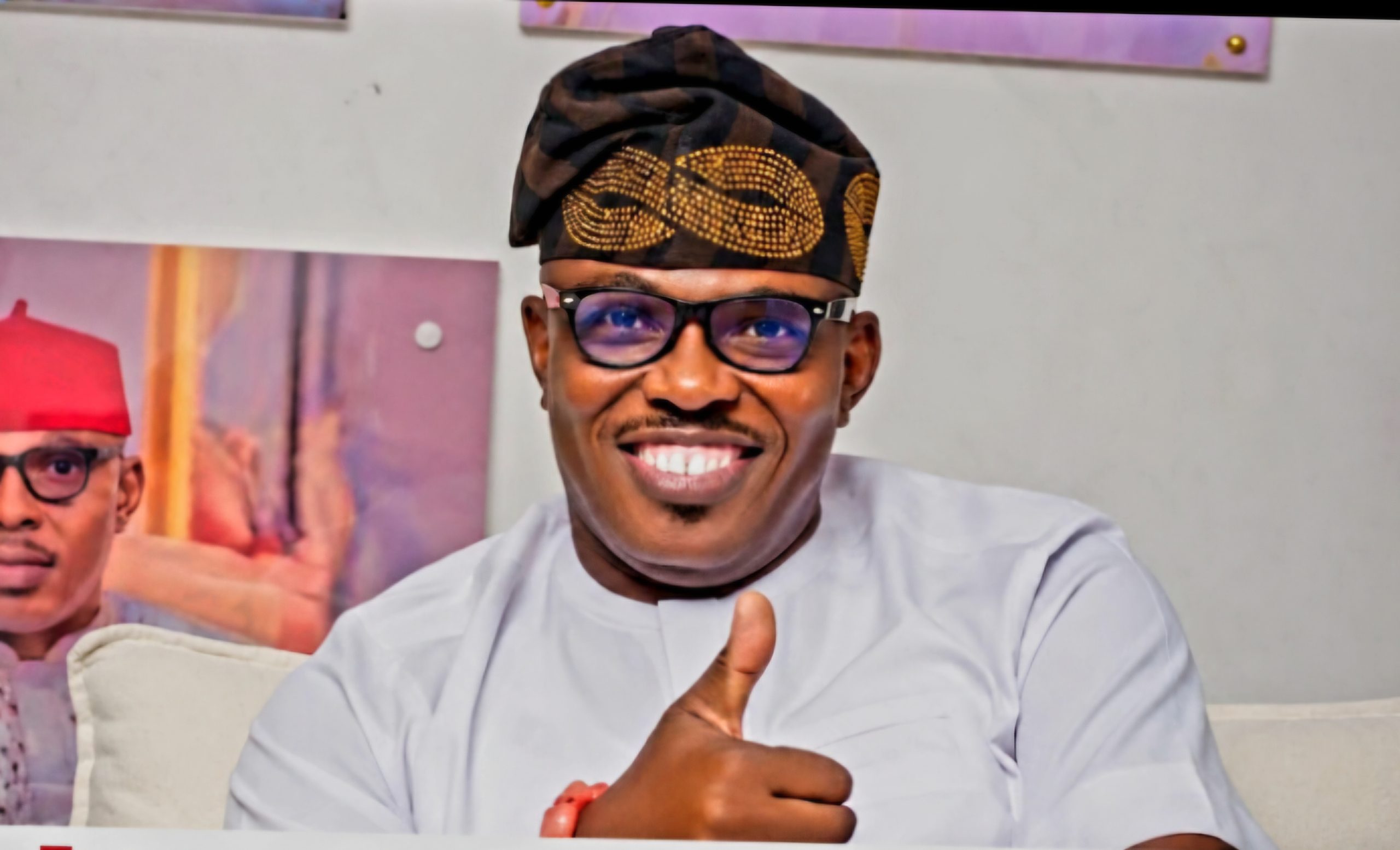
By: Ike Philip Abiagom
 Olorogun Innocent Esewezie, Executive Chairman of Oshimili North Local Government Area, with publishers during an interview in which he spoke on President Bola Ahmed Tinubu’s reforms, local government autonomy, ongoing projects and development initiatives in Oshimili North, among other issues.Olorogun Innocent Esewezie, Executive Chairman of Oshimili North Local Government Area of Delta State, has said the reforms of President Bola Ahmed Tinubu have given local governments greater financial room to operate and deliver development at the grassroots.
Esewezie made the assertion during an interview with a team Association Community Newspaper Publishers of Nigeria ( ACNPN), where he spoke extensively on his administration’s achievements, healthcare, security, roads, markets, workers’ welfare, local government autonomy, the administration of Governor Sheriff Oborevwori, the 2027 elections and his ambition to represent Oshimili North at the state level.
 The chairman also defended his support for President Tinubu and Governor Oborevwori, arguing that government policies should be assessed based on their impact on citizens rather than solely through political affiliations. Excerpts:
In our last publication, you described the President Bola Ahmed Tinubu administration as a change-maker and spoke about the pace of development under Governor Sheriff Oborevwori. Some readers subsequently asked why we did not adequately document many of your achievements, particularly your efforts in mobilising resources for the local government. Could you tell us what your administration has achieved and how these developments are affecting your communities?
Thank you very much for the question. Let me begin by welcoming you to the Oshimili North Local Government Liaison Office, which also serves as an annex office of the council.
On August 20, we are expected to commission the cottage hospital in Okpanam. We will also flag off a free medical programme, including various forms of surgery, such as fibroid surgery.
In addition, we plan to distribute about 2,000 medicated glasses to members of the community. Overall, we expect about 3,500 people to benefit from the free healthcare programme.
This is not the first time we have undertaken such an initiative. We did it last year, and we are doing it again this year because healthcare remains one of our priorities.
The programme will cost millions of naira, but the most important consideration is the impact it will have on the people. More than 3,000 people are expected to benefit.
Empowerment takes different forms, and healthcare is one of them.
We are also planning a major youth empowerment programme within the next two to three months. We intend to train young people in various vocational skills and provide them with starter packs and stipends to enable them to establish businesses.
What about security?
Security has received significant attention under our administration. We established the Oshimili North Security Watch, engaging about 150 people and providing them with the necessary equipment and security gadgets.
We have also installed surveillance cameras, with the control room located at the Ibusa Police Station. You can visit the station after this interview to see the facility.
For the past seven or eight months, the local government has enjoyed relative peace. According to the reports available to me, the surveillance system has helped us monitor activities across the area and respond more effectively to security concerns.
We have also constructed several kilometres of roads, with drainage on both sides. These are some of the projects we have implemented within the period under review.
Another important achievement is our commitment to workers and pensioners. We have no outstanding pensioners in the local government, and we pay salaries as and when due. We have also invested substantially in market infrastructure.
Some of the markets we have constructed include the Igbuzor Trans-National Modern Market, Ultra-Modern Market, Ugbolu Ultra-Modern Market, Illah Modern Market and Ebu Modern Market.
We have also approved another commercial market in Akwukwu-Igbo, while many of these projects are already about 90 per cent complete.
We have completed the Senator Peter Nwaoboshi Legislative Complex at Akwukwu-Igbo and awarded contracts for other projects, including the foundation of another complex.
There are many other projects we have undertaken. Our belief is that when a government is working, the results should be visible in the lives of the people.
The confidence we have comes from the support and commendation we receive from our people.
You have attributed some of these achievements to the reforms of President Tinubu. How exactly have his reforms affected local governments?
We have been able to achieve these things because, in my view, President Bola Ahmed Tinubu has created an environment in which local governments can access what is constitutionally due to them.
Before his administration, some states were still operating caretaker committees, with governors appointing local government chairmen without elections.
President Tinubu took a firm position that states should conduct elections into local government councils and that allocations should not be released to states that failed to do so.
Today, local government councils across the country have elected chairmen. I consider that a major development for grassroots democracy.
For decades, successive administrations have talked about the need for local governments to operate freely without undue interference from state governments.
President Tinubu has taken concrete steps towards achieving that objective.
The Supreme Court has also delivered a judgment on local government autonomy, and there is now a framework for implementing greater autonomy.
As we speak, the funds due to our local government are reaching us. We sit with other local government chairmen and determine how best to utilise the resources available to us.
The funds we receive, in my assessment, are sufficient to meet our obligations, including salaries and other council responsibilities.
We also have reserves, and those reserves enable us to execute many of the projects I have mentioned.
When I served as chairman previously, the situation was different.
Today, we have a President who is saying that local governments should be allowed to breathe, function and deliver for their people.
I believe that autonomy is helping local governments, strengthening grassroots development and improving the lives of our people.
You have expressed strong support for President Tinubu and Delta State Governor Sheriff Oborevwori. Why?
My support is not based on selfish interests.I am passionate about their leadership because I believe in what their policies can mean for my children, my family and our people.
When choosing a leader, we should look at capacity, track record, courage and decisiveness.
President Bola Ahmed Tinubu has demonstrated these qualities through several difficult decisions.
One of the clearest examples is the removal of the fuel subsidy. Before the 2023 election, virtually every major political party acknowledged that the subsidy regime was unsustainable. Previous administrations also recognised the problem, but removing the subsidy was politically difficult because of the consequences.
President Tinubu came into office and took the decision. The immediate consequences were difficult. Food and transportation costs increased, and Nigerians felt the impact.
But the important question, in my view, is whether the reforms will produce long-term benefits. I believe the reforms are already yielding results. The economy is growing, while infrastructure development is taking place across various sectors.
His administration has also prioritised the regular payment of salaries and implemented policies aimed at strengthening key institutions.
The reform of the electricity sector is also significant. The administration has opened the sector to greater participation by states and local governments, allowing subnational governments to develop electricity solutions within the framework of the law.
Security is another area.
President Tinubu inherited serious security challenges, including terrorism, kidnapping and other forms of insecurity. His administration has responded by restructuring and strengthening the security architecture, including improving the welfare of military personnel.
There has also been movement towards the establishment of state police. The proposal has gone through the National Assembly, and Nigerians are waiting for the next stage of the legislative process.
Within the period of his administration so far, the President has taken several bold decisions which, in my opinion, previous administrations struggled to implement.
Some people argue that political competition and the 2027 elections should determine whether the current administration continues. What is your position?
Politics is healthy. Competition for political power is part of democracy, and elections are necessary.
However, the desire for political power should not become an excuse to undermine a government that is working.
The fact that elections are held every four years does not mean that every policy or reform should be judged solely through the lens of politics.
We should assess performance objectively. In my view, President Bola Ahmed Tinubu should be allowed to complete his two-term tenure. Nigerians can then properly assess the total impact of his administration on the country.
Governor Chukwuma Soludo of Anambra State is a good example. He is a respected financial expert and former Governor of the Central Bank of Nigeria. He has, on different occasions, acknowledged the impact of some of the Federal Government’s economic policies, even though he does not belong to the same political party as the President.
You can also look at Abia State foe example, Governor Alex Otti is not an APC governor, yet he has publicly acknowledged the Federal Government’s role in creating an enabling environment for his administration to deliver projects.
This is important.
We often praise governors for their achievements at the state level, and rightly so. But we should also recognise the federal policies that create the fiscal and economic environment in which those achievements become possible.
In Delta State, Governor Sheriff Oborevwori has repeatedly acknowledged the importance of the resources and fiscal environment created by the Federal Government.
He has made it clear that, in his view, increased resources available to the state have enabled his administration to execute projects and deliver on its MORE agenda.
For us at the local government level, what matters is that these policies translate into tangible improvements in the lives of ordinary people.
Ultimately, governance should be measured by what people can see, feel and benefit from, not merely by political statements.
That is why we remain focused on delivering projects, strengthening healthcare and security, supporting our workers and pensioners, and improving infrastructure across Oshimili North.
You have also spoken about the relationship between Federal Government policies and development at the state and local government levels. What is your position?
The President has, in my view, been able to block many of the leakages in the economy, including the subsidy regime.
The important thing is that these resources are not being kept for selfish purposes. They are being channelled back to the subnational governments—states and local governments.
As a local government chairman, I can testify that the resources now available to us have made it possible for us to perform.
So, if you appreciate what we are doing at the local level, it is also important to recognise the Federal Government that has created the fiscal environment that makes these achievements possible.
That is why, when we campaign for President Tinubu, we are not doing so simply because we belong to the APC or because of personal relationships.
We are supporting him because we have seen his capacity, foresight, track record, courage and decisiveness.
His record in Lagos speaks for itself.
Since he left office, the state has maintained what I consider a stable and progressive development trajectory. Businesses are thriving, infrastructure has improved, and the foundation for many of the state’s present achievements was laid during his tenure.
That is the kind of leadership record we should examine when assessing a political leader.
You mentioned Anambra State and the business environment there. Why is that relevant to your argument?
Anambra State has tremendous potential, with commercial centres such as Nnewi and Ochanja Market.
However, for years, many people from Anambra have preferred to live, invest or conduct business in places such as Asaba and Warri because they consider the environment more conducive.
Asaba has become attractive because of its relative peace, business-friendly environment and infrastructure.
Governor Chukwuma Soludo is trying to reverse that trend by improving the business environment in Anambra.
Through the support and fiscal environment created by the President’s policies, his administration is also developing projects such as the new Ochanja Market.
The President’s philosophy, as I understand it, is that the Federal Government should not continue to control everything.
He has been devolving responsibilities and opportunities to subnational governments so that states and local governments can develop according to their specific needs.
What do you consider the biggest challenge still confronting Nigerians?
Security remains a major concern. Nigerians have experienced banditry, kidnapping and other forms of insecurity.
However, I believe the situation has improved in many areas.
In Oshimili North, for example, I receive daily situation reports from the Divisional Police Officers across the local government.
Based on the reports available to me, I can say that we have not recorded kidnapping incidents across the divisions recently.
We will continue to support the security policies of the state government and President Bola Ahmed Tinubu.
Let’s talk about boundary delineation between Asaba in Oshimili South and Okpanam in Oshimili North. It has been a subject of controversy over the years. What is the situation now?
Boundary demarcation is not the responsibility of a local government chairman. It is strictly within the preview of the appropriate state authorities, particularly the office of the Deputy Governor.
What we can do at the local government level is provide information, cooperate with the relevant authorities and ensure that the interests of our people are properly represented.
Asaba is the state capital, and communities within the capital territory have historically faced situations where their land and identity become absorbed into the wider development of the capital.
For example, when Obi Cubana sought to develop part of the Okpanam area for real estate, there was an issue involving Okpanam and Issele-Asagba.
I intervened because the matter affected the local government and the interests of the communities involved.
Based on the evidence available at the time, the land was eventually recognised as belonging to Okpanam.
However, once development took place, many businesses and property owners naturally preferred to associate their investments with the name Asaba because it is the state capital.
So, regarding the boundary issue, no local government has the authority to determine or alter state boundaries. That responsibility rests with the appropriate state authorities.
Therefore, I cannot accept the claim that I have abandoned something that is not within my statutory powers to determine.
The Asaba Specialist Hospital was established and named by the state government.
This illustrates the broader point that developments within the state capital territory often have implications beyond individual communities.
That is why boundary and territorial matters require coordination with the state government rather than being treated as a purely local government responsibility.
You are the Delta State Co-ordinator of the City Boys Movement. What is the group’s role in the current political dispensation, particularly within the APC?
The City Boys Movement is a pressure group within the APC established by young Nigerians to support President Bola Ahmed Tinubu. It operates across the federation.
Our primary responsibility is to reach out to young people and counter misinformation and what we consider negative propaganda about the President and his policies.
We recognise that three years is not enough to implement every aspect of the President’s programme.
Therefore, our responsibility is to explain his policies to Nigerians and communicate the progress we believe is being made.
Our target is not limited to APC members or politically active young people.
We also reach out to people outside the political sphere, including women and young people in rural and urban communities.
Our message is straightforward: Nigerians should assess the President based on his policies, achievements and capacity to deliver.
We have also set a target of mobilising 2.7 million votes for President Tinubu in Delta State. This is not merely a political slogan. We have structures in place at the local government, senatorial, federal constituency, state, ward and polling-unit levels.
At the ward level, we have coordinators, while at the polling-unit level, we have male and female coordinators working to engage voters. We want people to understand that development is a collective process.
When a governor performs well, people naturally credit the governor. When things go wrong, however, many people immediately blame the Federal Government.
We are trying to help people understand the relationship between federal policies and what happens at the state and local government levels.
The reforms of President Tinubu have, in our view, created an environment in which governors, local government chairmen, senators and members of the House of Representatives can perform.
If a federal legislator attracts constituency projects, for example, the funding environment created by the Federal Government is part of what makes those projects possible.
So, the progress we are seeing should be understood as a collective effort, with the President driving the process.
You and other political leaders recently visited Ebu Community and made commitments at the palace of the traditional ruler. What steps are you taking to ensure that the community’s concerns, particularly the deplorable road, are addressed?
Let me first say that the visit to Ebu was not a political scam as stated by some opposition parties. It was a genuine response to the condition of the community.
Ebu is part of Oshimili North, and we have a responsibility to the people there. During our visit, we saw the deplorable condition of the roads and understood the difficulties it was causing residents, businesses and transporters.
The visit was also a decision reached by the APC leadership. We felt it was important to go directly to the community, listen to the people and assure them that they had not been forgotten.
We pledged to use every means available to us to ensure that something was done about the road urgently.
I am pleased to inform you that our working Governor has also directed the Ministry of Works to inspect the road.
Officials have visited the area and carried out the necessary assessment. I want to assure the people of Ebu that, based on the information available to us, work is expected to commence on the road soon.
We have also continued to engage the relevant ministry, and they have assured us that action will be taken.
Our visit was therefore not merely symbolic. We have followed it up with engagement with the authorities responsible for the project.
The people elected us, and it is our duty to respond whenever their communities face serious challenges.
What legacy do you want to leave behind when you eventually leave office?
I want to be remembered as a local government chairman who came at a critical time and distinguished himself through development.
For me, the first responsibility of government is security.
Our people must be alive and safe before they can participate meaningfully in economic and political activities.
We are therefore doing everything possible to ensure that people can conduct their businesses freely, return home safely and sleep peacefully.
This is not limited to Ibusa or Okpanam. Our goal is to make every part of Oshimili North peaceful and secure.
We are supporting the security policies of the state government and ensuring that our local security structures remain effective.
The second area I want to be remembered for is healthcare.
I want people to be able to say that during my tenure, someone who needed medical attention could go to the cottage hospital and receive proper treatment.
That is one of the reasons we are investing in the cottage hospital.
Primary healthcare is extremely important to our people.
We did not want to build a facility simply for the sake of having a hospital. We wanted to provide a standard facility that even public officials could confidently use.
After the commissioning, if my son or daughter requires medical attention, I want to be able to say, “Go to the cottage hospital and get treated.”
We will continue to improve the facility by purchasing and stocking the necessary equipment.
By the time we leave office next year, I want the hospital to have reached a standard where the essential services and equipment are available.
I want to be remembered as a chairman who served his people so well that they decided to entrust him with greater responsibility.
Oshimili North has invested a lot in me, and I believe the time has come for me to give even more in return by becoming their voice at the state level.
If elected to represent the people of this local government, I will speak for them, defend their interests and ensure that Oshimili North receives greater attention in the state budget.
One of my objectives is to ensure that the local government is properly connected to the state’s development and budgeting process.
I believe that having someone who understands the system and has experience in local government administration can help attract more opportunities and resources to the area.
My promise is simple: I will be the voice of Oshimili North, defend the interests of our people and work to ensure that this local government benefits from opportunities that it may not have enjoyed sufficiently in the past.
I also appreciate the state government for the support and development it has brought to Oshimili North.