[dropcap]R[/dropcap]eformed Niger Delta Avengers, (RNDA), a splinter group of dreaded militants group, Niger Delta Avengers, NDA, has accused Governors in the nine states of the Niger Delta region of mismanaging the 13 percent derivation fund meant to develop host communities in the region.The group stated this in a statement while calling on President Muhammadu Buhari-led federal government to stop paying 13 percent fund to the Governors but rather pay it directly to the Niger Delta communities.
They also made a fresh demands for the quick release of the Gas Flare Penalty Funds to the affected oil producing communities in the creek of Niger Delta through the leadership of Host Communities of Nigeria, HOSTCOM, led by Dr Mike Emuh.
According to report, leader of the group, self-styled, “Major General Johnmark Ezon-ebi” aka Obama, who spoke on after a crucial meeting of the commanders at Bini River, Delta state, said: “The Reformed Niger Delta Avengers with the coalition of the nine militant groups in the creeks urge Mr President to do the needful in order to quickly remove the 13 per cent derivation funds from the hands of the Niger Delta state governors.”
Accusing the governors of corruption and not managing the funds well, the militant asserted, “We want the money removed from them because they failed woefully to utilize the money, which amounted to trillions of naira to develop the oil communities in the creeks of Niger-Delta.
“By the relevant Section and Act of the Constitution that established 13 per cent derivation, RNDA is advocating payment of the funds to the oil producing communities in the various states that produce crude oil to be managed by the Host Communities of Nigeria, HOSTCOM,” he said.
[dropcap]T[/dropcap]he 2019 elections have come and gone. With the battles over, all seem not be settling well with immediate former governors of some states following allegations of financial misappropriation riddled against them during their stay in power. These allegations are coming mostly from their successors, after they allege that the ex-State Chief Executives from documents and reports at their disposal shows a high level of financial embezzlement carried out by them.
Below are three immediate formers governors who may face the anti-graft probe over allegations of misappropriation of their state funds.
Mohammed Abubakar (Bauchi)
Mohammed Abubakar was elected Governor of the North East State of Bauchi in 2015 on the platform of the All Progressives Congress, APC, but unfortunately lost his re-election bid in this year’s general elections.He lost to Bala Mohammed of the Peoples Democratic Party, PDP, who a couple of days ago alleged that the ex-governor misappropriated the sum of N2.3bn to buy materials for burial in the state.
The governor, who spoke through his spokesperson, Dr. Ladan Salihu, in an interview with journalists in Bauchi, said the funds were spent between January and May, 2019. He explained that over N900m was spent on the purchase of white cloth used for wrapping corpses while over N1.4bn was used to buy the wood for lacing the graves after burial.
According to him, the government discovered issues of corruption, venality, daylight robbery of the commonwealth of the people of the state, adding that there were documentary evidence to prove that.The governor’s spokesman vowed that the state government would use every instrument of the law, including petitioning the Economic and Financial Crimes Commission, EFCC, the Independent Corrupt Practices and other related offences Commission, ICPC and other anti- corruption agencies on the matter, “until every kobo stolen is returned.”
Abdulaziz Yari (Zamfara)
Abdulaziz Yari is the immediate past governor of Zamfara State. He was elected as the state Chief Executive in 2011 and reelected in 2015 on the platform of the All Progressives Congress, APC.
Ex-Governors Buhari Must Not Appoint Into Cabinet Only yesterday the former governor was indicted by the Transition Committee set up by the State Governor Bello Matawalle over allegation that he misappropriated N251, 951,849,482.50 during his tenure.This was revealed to journalists on Monday by the Chairman of the Transition Committee and immediate past Deputy Governor of the state, Mallam Ibrahim Wakkala.
Wakkala said: “My committee while trying to ascertain the liabilities left behind by the immediate past administration of Hon. Abdulaziz Yari collected and went through the report submitted by a Transition Committee earlier set up by former Governor Yari.
“We discovered from Yari’s committee that the sum of over N250 billion cannot be accounted for.“This included
liabilities from a total of 462 ongoing projects, which stands at N151,190,477,572.02, and unremitted National Housing Fund and unpaid workers’ gratuity of N1,431,645,305.99.
“Similarly, the state government is indebted to various examination bodies, including NECO and WAEC and some higher institutions, amounting to over N2.8 billion.”
Wakkala said the outgone administration, which released N2 billion for the payment of gratuity to retired workers, only paid N400 million to retired Permanent Secretaries, while the remaining balance of N1.6 billion had remained unaccounted for.With these allegations, it is not uncertain the EFCC or ICPC whether or not will go after the former governor to account for these allegations.
Rochas Okorocha (Imo) Though no financial allegations have been officially made by the current Governor of Imo State, Emeka Ihedioha or any public official in the state against the immediate ex-governor, now senator representing Imo West Senatorial District, Rochas Okorocha, it can’t be ruled out that he will be totally free from any probe.
This is in view of the constitution of a financial advisory committee saddled with the task of carrying out a forensic
audit and reviewing “all financial transactions” under Okorocha’s administration. The committee was inaugurated on Monday, June 10, 2019.
Ihedioha had approved the constitution of the committee which is expected to review loans and financial disbursements approved by Okorocha who presided over the state from 29 May 2011 – 29 May 2019.
The committee has the former Director-General of Debt Management Office (DMO), Dr. Abraham Nwankwo, as its chairman, and Mr. Nick Opara Ndudu as its secretary.
[dropcap]T[/dropcap]he Chief Executive Officer, MultiChoice Nigeria, John Ugbe, has disclosed that the winner of the Big Brothher Naija Season 4 , will go home with N30 million cash prize. Ugbe said the theme for the 2019 edition of BBNaija is ‘Forget Wahala’.
The CEO noted that each edition of Big Brother Naija significantly improves on all aspects of the previous season , adding this year ‘s edition is no different”. He stressed that: “The winner of season four will walk away from the house with a N30 million cash prize and a top of the range SUV, amongst many other exciting prizes.
“The Big Brother Naija winner will also emerge as ”the most popular and marketable personality on the continent, as the show is known to launch prominent careers in arts, entertainment and other supporting industries,” Ugbe added.
While the location of the house has not been revealed, fans of the show have nonetheless been excited since the announcement was made earlier this year. Since its maiden edition, BBNaija has produced many celebrities.
They include Ebuka Obi-Uchendu, Gideon Okeke, Bisola Aiyeola, Efe Ejeba, Miracle Ikechukwu, Tobi Bakre and Cynthia “Cee-C” Nwadiora.
[dropcap]C[/dropcap]hief Chris Uche (SAN), the lead counsel to the Peoples Democratic Party and its presidential candidate in the February 23 election, Atiku Abubakar, said they will appeal to the Supreme Court the decision of the Presidential Election Petitions Tribunal not to allow them access to server and card reader the Independent National Electoral Commission (INEC) used during the election.
Uche said the decision of the tribunal would be challenged at the apex court, adding that section 151 of the Electoral Act allows them to inspect materials used by INEC for the election.
The Presidential Election Petition Tribunal (PEPT) sitting in Abuja, had on Monday declined to grant the application filed by Atiku and PDP access to inspect the server and data of smart card reader said to have been deployed by INEC in the conduct of the presidential election.
Presiding Justice of the five man panel, Justice Mohammed Garba, in a ruling held that granting of the application would imply that the court have delved into and resolved the contentious issue of the existence of a central server at INEC.
The Chairman added that doing so would further create the impression that the tribunal has concluded that there is a central server where results of the February 23 election were received and stored.
Uche pointed out that the nation is looking forward to the ruling of the tribunal on the petitioners application seeking to Inspect the electoral materials, which he noted is pivotal, Uche said granting the application would in no way prejudice the substantive matter.
“INEC he said is a public institution and had mentioned having a central server and wondered why it turned around to say it has no server.
“We are not asking the court to decide whether there is a server or not, so the aspect of the court prejudging in the issue doesn’t arise at all. All we are saying is that the court should allow us access to inspect the materials which we are entitled to as INEC is a public institution funded by public funds.
“So we are going to challenge that.”
Chief Mike Ozekhome SAN, one of the counsel to the petitioners, also reacting said: “INEC chairman himself, professor Mahmoud Yakubu has maintained again and again before and during the election that there is a central server, that results were going to be electronically transmitted to that central server. And all the Electoral Commissioners maintained that the stage we are in now is a technological stage where things would not be done manually and anything not done with the PVC which results would be transmitted electronically to the central server would not be valid.
“What the court have said today is like more or less that you don’t have the right under section 151 of the Electoral Act to maintain your petition, but we didn’t ask for details, we didn’t ask for content, all we asked for is to allow us access.“So it is not an issue. We are appealing the decision because it is like trying your hands behind your back and expecting you to fight. We are appealing the decision because we want to know what is in the central server that they are hiding”.
He added that the public is also interested because budget was made for procurement of the central server in billions and it was approved by the National Assembly and it was disbursed. And INEC said they have done all that. So where is the money, what is there that they are hiding.
“This is not just a case between Atiku and Buhari, it is a case that have generated Public interest for electoral transparency, credibility and freedom,” he said.
The tribunal had on June 13 reserved ruling in the application filed by Atiku and PDP on May 8, for access to inspect INEC’s central server and smart card reader allegedly used in the conduct of the February 23 presidential election.
However the tribunal in a unanimous decision refused to grant the application on the grounds that since parties have joined issues, the tribunal cannot at the interlocutory stage make an order that would affect the substantive issue.
“I decline to grant the relieve sought, this application is refused and accordingly dismissed”, Justice Garba held.
[dropcap]U[/dropcap]nited Bank For Africa, UBA,Group Executive Director, Liadi Ayoku has advocated an overhaul of the University curriculum, particular, financial institutions across Africa to reflect current technological realities.
The overhaul of the University curriculum. according to Ayoku, the UBA Executive Director should reflect the modern business expectations of the present day in order to ensure the relevance of graduates to the continent’s economic growth and aspiration.
The UBA, top shot, who spoke at the annual lecture of the Faculty of Management Sciences, Lagos State University ,LASU, explained that finance graduates and professionals must be aware that it was no longer business as usual following the fast-changing technological landscape. Speaking on ”The Future of Finance-technology at play on in the University on Wednesday, June 19, 2019, he lamented “I am not certain if the finance and accounting graduates of today are familiar with modern financial software packages, including global accounting and financial reporting standards”.
he noted that they have even been imbibed with the ready-to-market soft skills like leadership, communication, commercial acumen, flexibility/openness to change and strategic vision?, which makes s the case of financial graduates more worrisome. It is therefore, not surprising why he has proposed an overhaul of the university Financial curriculum to accommodate theseinadequacies of finance and accounting graduates.The UBA top Executive further explained that with technology replacing basic manual financial accountings , the” finance professional that would excel in the future must be quick to retool and adapt to changes”.
According to him, ”traditional knowledge of finance is getting stale in today’s business world and” and indeed the dire need for retooling our skills if we must remain relevant n tomorrow’s financial world. ”Technology is fast replacing the basics of finance,” he had said.
Given an insight about the modern business trend, he disclosed that financial reporting is increasingly being automated, just as data analytics is demystifying performance analysis. Tomorrow’s finance professionals must have capabilities for business intelligence and cognitive analysis. “We must appraise ourselves of the most recent technology and continue to retool our skills to remain relevant today and into the future,” he had said.
Participants At The LASUU Faculty Of Managment Lecture
Rotimi Oladele, the Executive Secretary, Institute of Entrepreneurship and the Chairman of the occasion, was aid to have , commended Ayoku for delivering a profound paper worthy of equipping account graduates for a future driven by technology.
The event may have provided an opportunity form to pay glowing tribute toTony Elumelu, founder , Tony Elumelu Foundation and Chairman, UBA, over his contribution to entrepreneurship development in Africa, Describing him as a ‘‘global brand of the rarest value’”. He is optimistic that LASU would benefit immensely from its collaboration with the entrepreneur turned philantropist.
Describing the UBA Chairman, not just as a” Nigerian of rare value but a Premium African of rarer value and of course a Global Brand of rarest value”.
Throwing more light to his impression of the global icon and entrepreneur he noted that he is known the world over, particular Africa, for” breeding entrepreneurs and start-ups in thousands and with millions of dollars ceaselessly in support for sustainability”.
Olade, the Chairman of the occasion, who was quick to point out insists that” LASU partnering with Elumelu could be the best testimonial of a befitting support to the most multi-cultural and multi-tribal university in Nigeria. The profile of LASU Staff and studentship speaks for itself,” he said.
Lanre Fagbohun, a Professor and the University Vice Chancellor, represented by Oyedamola Oke, also a Professor and the Deputy Vice Chancellor, who could not hide his feelings thanked UBA for its” support and sponsorship”. He stressed that the bank believe in the support of education is indeed a special trait that could not be rivaled by any financial institution in the country for now and Africa in general.
[dropcap]T[/dropcap]HE Central Bank of Nigeria says the country’s external reserves now stand at 45 billion dollars as of June 2019.The CBN Governor, Mr Godwin Emefiele, disclosed this while reeling out the policy road map for his five years the second term in Abuja on Monday.
Emefiele said the bank put all necessary measure to ensure the steady growth of the country’s external reserves after the recession. “I am delighted to note that our external reserves have risen from 23 billion dollars in October 2016 to over 45 billion dollars by June.
“Inflation has also dropped from 18.72 per cent in January 2017 to 11.40 per cent in May.
“Our CBN purchasing manufacturers index has risen for 26 consecutive months since March 2017, indicating continuous growth in the manufacturing sector.
“As a result of measures implemented by the CBN which improved access to raw materials and finance for manufacturing firms GDP growth has risen for seven consecutive quarters following the recession.
“And, our exchange rate has appreciated from over N525/$1 in February 2017 at the Bureau De Change window to N360/$1. “With the improved inflow of foreign exchange, the exchange rate has remained stable around N360/$1 for the past 27 months,” he said.
According to him, with concerted efforts by the monetary and fiscal authorities the bank implemented a series of measures which led to the recovery of the economy from the recession by the 1st Quarter of 2017.
Speaking on recovery efforts, Emefiele said part of the measures deployed to support the recovery included tightening of the monetary policy rate in order to rein in inflation.
He said the bank also created an Investors and Exporters Window which allowed exporters and investors to inflow and sell their foreign exchange at the prevailing market rate. “In order to reduce our reliance on the importation of items which could be produced in Nigeria, we restricted access to foreign exchange on 43 items.
“We also deployed our intervention funds to support growth and productivity in the agricultural and manufacturing sectors.
“These measures helped to support the attainment of our monetary policy objectives such as a reduction in the inflation rate, stability in our exchange rate and improved accretion to our external reserves,” he added. (NAN)
[dropcap]T[/dropcap]HE Ndigbo Lagos, the umbrella body of all Igbo organizations in Lagos, says that its attention has been drawn to the recent call by a Traders Association, better known as Miyetti Allah Cattle Breeders Association of Nigeria, MACBAN, for the establishment of Fulani Youth Vigilante groups in communities of the South East.
Tony Eze, the director of communication and strategy for Ndigho Lagos said in a statement that while it commends the group for their interest to help find a lasting solution to the increasing menace of herdsmen, that Ndigbo Lagos “rejects their call in its totality, and applaud the President General of Ohaneze Ndigbo, Chief Nnia Nwodo, and the leadership of Afenifere for roundly condemning and rejecting such a senseless impunity from the Miyetti Allah leadership”.
“We are convinced such a call will not serve an effective complimentary effort to the existing legally instituted security architecture in place in Igboland, and will want to assure them that the South East has enough youth, manpower and capacity to compliment the efforts of all state actors in their bid to end the menace of Fulani herdsmen, kidnappers and armed bandits in the zone.”
He noted that Miyetti Allah is a nondescript body unknown to the nationalities structure of Nigeria.
‘’Hence, we call on them to continue in the path of demonstrating good faith by simply reigning-in these killer herdsmen, who if probed deeper, may not be unknown to their members,’’ he added.
[dropcap]P[/dropcap]resident Muhammadu Buhari would have been recorded as the worst Nigerian leader—ever, if he had lost the 2019 presidential election. Yet, his victory was not due to any popularity with the Nigerian people. And it had nothing to do with any electoral manipulation as commonly claimed within the opposition ranks. Buhari merely emerged as a better alternative in an election generally viewed as a binary contest between a devil and the deep blue sea. But the poor public perception of the president was equally neither lack of good intentions nor lack of efforts. It was squarely his failure to grasp a simple leadership lesson that is much more consequential.
The common saying, “all politics is local” came from the book, Man Of The House, and has become a commandment among politicians. But the book features other essential lessons that deserve more audience, especially in developing democracies. In that book, Thomas “Tip” O’Neill, Jr., a former US Speaker of the House, analyzed leadership in relation to the American presidents who served during the 34 years he was in the Congress.
On his fellow Democrat, James “Jimmy” Carter; Speaker O’Neill wrote: Once he gained the presidency on a mantra of change, after eight years of Republican rule, the Carter people—most of who came from his native Georgia—besieged Washington DC with every sense of arrogance. Jimmy Carter failed to realize that the skills used in winning the presidency is far from the “skills he needed to be effective once he got there.Many of the Carter appointees who came into the federal agencies acted as though they were hired strictly on merit, and didn’t owe anything to anybody. They refused to see themselves as team players.” O’Neill added that the Carter people were clueless about how Washington works. Even when it was clear that they were wrong, they still refused to change. The United States became a laughingstock around the world, and Mr. Carter would eventually leave office as the worst American president in recent memory.
Tip O’Neill explained that Carter’s failure had nothing to do with lack of hard work, intelligence or integrity. “When it came to understanding the issues of the day, Jimmy Carter was the smartest public official I’ve ever known. The range and extent of his knowledge was astounding…Carter’s moral zeal was admirable, but morality and intelligence are not enough in politics. You need a third ingredient—political style—and this, I say, is what Carter lacked in Washington.” Political Style!
Muhammadu Buhari moved into Aso Rock with good intentions, as well as a groundswell of public good will, promising to usher in positive change, after sixteen years of misrule under the Peoples Democratic Party. Overall, President Buhari recorded measurable success in the area of infrastructure, transportation, war against corruption; and diversification of the economy through agriculture. However, even as his achievements may appear admirable, they failed to engender the desired progress—socially, politically, and economically—because of his style of governance.
The Buhari’s style is a leadership miasma, offensive enough to turn his friends into foes. In short, the president made the exact same leadership mistakes Speaker Tip O’Neill warned against. Like Jimmy Carter, despite the protean character of the Nigeria’s abundant human resources, Buhari’s think-thank was a coterie of antique yes-men he claimed to have known from the yore, most of who have no clue about what makes the country tick. Like Jimmy Carter, before assuming office, Buhari worried that the presidency had become overly imperial, but the attitude of his inner circle while in power painted a different picture. Even on occasions where the Buhari people were linked to naked corruption, the president would greet the citizenry with either deafening silence, indifference or peculiar lack of compunction.
Such posture is a microcosm of Buhari’s style throughout his first term. Examples abound, but the most alarming, of course, is his attitude towards the systemic injustice in first 4 years. Understandably, a segment of Nigerian socio-political elites—from both the North and South—most of who influence the country’s image home and abroad, vehemently opposed the president’s style. The result was a montage of worldwide propaganda that successfully painted Buhari as an unapologetic dictator, nepotist, ethnic jingoist, jihadist, and a bigot—all roped in one and same agbada garb. The immediate effect was sweeping investment fears locally and internationally, which contributed in no small measure to the economic crisis that followed.
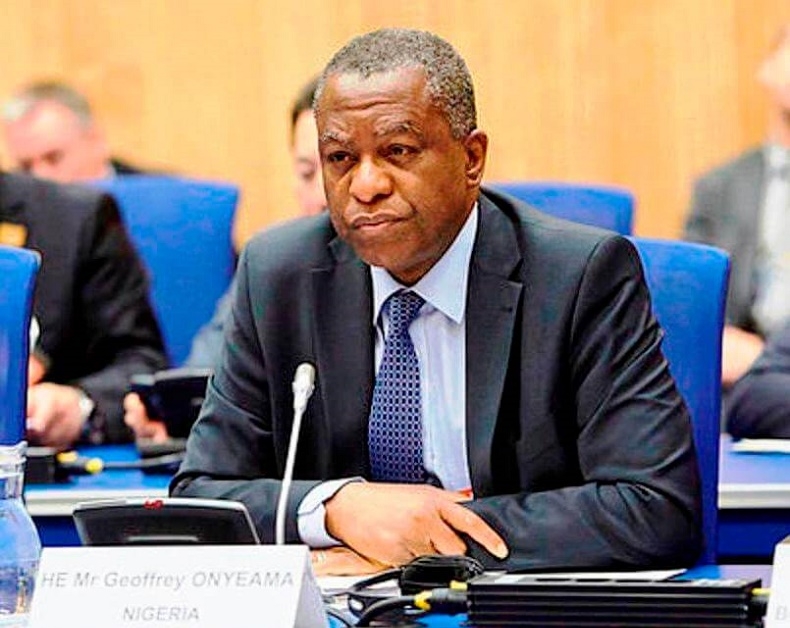
The Buhari presidency would recognize that something was amiss. It quickly budgeted billions to shore up his image around the globe. The official messengers were the Ministers of Information and External Affairs, Lai Mohammed, and Geoffrey Onyeama, respectively. Convinced that the duo was not producing the desired results, Buhari was deceived to create a redundant but bogus entity, named Nigerians Diaspora Commission, headed by Abike Dabiri-Erewa. But their whole effort translated to mere ‘talk and go’—akin to attempting to fetch water with an Ugbo basket.
The imprudent approach to Nigeria’s global image is mind-numbing. The Buhari envoys even chose to defy the logic of the common knowledge that “all politics is local”. It never dawned on them that the days are gone when Nigerian government can preach justice abroad while promoting injustice at home. The inconvenient truth is that the country now boasts of millions of independent ambassadors, strategically entrenched in all the nooks and crannies of the world, who tell it as it is. Some of these Diaspora Nigerians have also become Biblical Josephs of sort and thus play influential role in the nation’s foreign exchange, foreign trade, foreign investment, the media, as well as other socio-economic relationships. Needless to remind that the same Josephs are the leading block contributor to the yearly amount of foreign money remitted to Nigeria, which is ironically more than the national budget. As they go, so goes the national image and much more.
Nothing exposed the degree of ignorance within the Buhari presidency than its approach with the Biafran activists on the international scene. Instead of exploring dialogue, as was the case with Boko Haram, the Buhari regime not only used brute force on the Biafran activists but also shamelessly embarked on an aggressive global campaign to brand the secessionists as terrorists. It is not mystifying, therefore, that the Nigerian group, besides Boko Haram, that came to be recognized outside the country as terrorists are the Fulani herdsmen, the very outfit the president serially refused to acknowledge as a threat to civil order.
Today, though Buhari might have recorded some improvement on the war against terrorism and corruption, Nigeria’s global ranking on both categories has worsened since he took office in 2015. Today, the threats of secession have become the loudest since the civil war. Today, the country’s global image is most gloomy since returning to democratic rule in 1999. The general toll on the national economy is staggering, and the masses are the victims.
The solution is simple: a presidential leadership style that embodies equity, justice, prudence, and tolerance for opposing views. The fear, however, is that President Buhari may care less. Since being re-elected, the polity has been inundated with symphonies of praises by pandemic sycophants, most of who are goading him to stay the status quo—just to prove a point. But Buhari should consider the posterity and demonstrate true leadership. Even as it is vitally important for leaders to be unwavering in their convictions, any worthwhile conviction ought to advance the greater good. Moreover, political rigidity is another name for dogmatism, which typically leads to destructive power. SKC Ogbonnia is the author of the Effective Leadership Formula.
[dropcap]B[/dropcap]arring any unforeseen development, the People’s Democratic Party’s (PDP) Presidential candidate in the 2023 general elections would be from the South East extraction,Grassroots Publishers can reveal.
While it was gathered that the choice of former Anambra governor, Peter Obi as the running mate to the party’s Presidential flag bearer in the 2019 election, Alhaji Atiku Abubarkar was carefully designed and. in line with this resolve, it has also been gathered that the party deliberately decided to pick its next Presidential candidate from the Eastern part of the country to demonstrate its reputation of a true national party aimed at giving every region a sense of belonging.
Sources within the PDP mentioned that the party still believes it will be in government before 2023 to conduct that year’s elections and has thus, resolved to end the frustration of the Igbos over their inability to get a go at the nation’s presidency, by presenting an Igbo presidential candidate.
” The PDP believes the outcome of the current presidential election tribunal will favour it and has resolved to at least for once make the Igbos feel they are Nigerians by handling them the barton in 2023″ an Ibadan based leader of the party told The Grassroots Publishers.
It was also gathered that seeding the Presidential slot to the East will make the North get the Vice Presidential slot while the Speaker of the Senate goes to the Southwest. Speaking in the same vein on a Lagos radio station, Classic FM on Sunday, a PDP Chieftain, Chief Olabode George said there is no reason doubting the resolve of the party from picking its candidate from the Eastern part of the country.
He said its a concluded matter for the party adding, that there is no development on ground so far, that could make the resolve change.
Meanwhile, former Senator representing Kaduna Central in the 8th Senate, Comrade Shehu Sani, has hinted that it is only natural to allow for an Igbo President in 2023 because the north has had its fair share of controlling power more than any other region in the over 50 years of nationhood.
Shehu Sani’s warning may not be unconnected with recent media reports credited to the Chairman of Arewa Youths Consultative Forum, Mallam Shettima Yerima who is insisting that the north will still produce the nation’s President in 2023.
Excluding any part of Nigeria in the scheme of things for whatsoever reasons, he argued, amounts to simply fueling the already tensed situation and igniting anarchy which, if fully set, will spare no one, including those in the position of authority.
Comrade Sani in an interview after delivering a keynote address at a one-day youth awareness forum, “Niger Open Forum” organised by The Blue Revolutionaries (TBR) over the weekend, warned of dire consequences of blacklisting any part of the country.
”Appointments into key positions, every region must be carried along. Doing anything, on the contrary, means simply feeding the anarchy, feeding secessionists, feeding the merchant of crisis in this country”.
President Buhari, he said must give a sense of belonging to every segment of the country, insisting that, “If you exclude the Eastern or the South-South part of the country, or even the north-central part of Nigeria because they didn’t vote for you, you are simply feeding the anarchy, feeding the secessionists, feeding the merchant of crisis in this country”.
“It is expected that when you win elections under any party platform, you are for everybody. We have a pattern in this country where people are excluded and marginalised out of government on the basis that their ethnic or religious group did not vote for the government in power, that is very dangerous”.
Shehu Sani argued that “After elections you need a country to rule and you cannot rule one part and abandon the others. So, that is my view”.
He also warned that it would amount to laying land mines any attempt to deny the South the Presidency in 2023, saying the north has had its fair share under President Mohammadu Buhari.
“My position is that the north has had its own fair share of leadership under President Mohammadu Buhari. Anybody who is saying power should remain in the north even after Buhari is simply laying a land mine for Nigeria’s destruction”.
Although it is ‘too premature” to start talking about who succeeds President Buhari in 2023, Shehu Sani reminded those championing continued holding onto power by any northern candidate after the current dispensation that what keeps a nation together is equity, fairness and justice for all.
“There is the need for us to understand that it is not simply about winning elections that keeps a nation, it is about being able to stabilize and balance all the forces that make us as a people” he said.
[dropcap]P[/dropcap]resident Muhammadu Buhari, who is in a hurry to fix the nation’s battered economy in the next four years , appear to have given a clue that technocrats would dominate his ministerial list and appointment into government agencies, with the recent appointment OF Mele Kolo Kyari, a former General Marketing, Crude Oil Marketing as the Group Managing Director of the Nigerian National Petroleum Corporation, NNPC , and the reconstitution of the management team.
This may have given hope to Nigerian Customs personnel that if he also decides to drop Hameed Ali, a retired Army Colonel and Comptroller General , Nigerian Customs Service, NCS, he may appoint a serving Comptroller, which is an equivalent of a General Manager in the state oil Company ,who has functioned in the government revenue generating and enforcement agency in various roles to take over fro.
The Katsina born Nigerian President may have disappointed politicians who had reached out to their contacts in the Presidency, particular, some of the former members of the kitchen cabinet who still have his ear to put in words for them to be given appointment in NNPC.
He may have been encouraged to thinker with the option of bringing in more technocrats into the new government because of the Performance of Ngozi Okonjo- Iweala, a World Bank, top Executive, and former minister of Finance and Coordinator of the Economy and Akiwumi Adesina, another former minister of Agriculture and Rural Development and now President , African Development Bank, ADB in the erstwhile Goodluck Jonathan Administration.
Mele Kolo Kyari: Waiting On The Wings To Take Over As NNPC, GMD
Note that most of the policies that had been implemented by the President in the last four yes on the economy, particular the Agricultural sector and the introduction of the Bank Verification Notice, BVN, were initiated by the duo in their respective ministries while still inoffice .
It is not surprising why the President may have sent a signal to the politicians lobbying for appointment to forget about the key ministries, agencies and departments that are vital to the growth of the nation’s economy which he insists would be manned by technocrats.
Kyari , is expected to work with Umar Isa Ajiya, Chief Financial officer, North west, Roland Onoriode Ewubare, south-south, COO, Upstream, Yinusa Yakubu, COO, Refining and Petrochemicals, north central, Yusuf Usman,COO, Gas and Power, north east, according to Ndu Ughamadu, the Corporation General Manager, Public Affairs Department, PAD, in the reconstituted management team.
Others on the list are Lawrencia Nwadiabuwa Ndupu, south east, COO, Ventures,Adeyemi Adetunji, south west, COO, Downstream and Farouk Garba, COO, Corporate Services.
Iapparent reaction to the appointment of Kyari, a noted technocrat as the GMD, of NNPC, Mohammed Sanusi Barkindo, a former GMD, of the Corporation and now Secretary General, Organisation of the Petroleum Exporting Countries, OPEC, described it as ”surprising but a deserving position” for him.
The former NNPC, boss , disclosed that the President has made a bold Statement that ”exemplary record and exceptional performance will count in his appointments this time around, stressing that the new NNPC boss had worked in a variety of strategic Departments where he had distinguished himself as a great performer.
Kyari’s appointment may not have taken off with immediate effect. this is because Mikanti Baru, the incumbent Group Managing Director tenure would elapse on July 18, 2019, when he would proceed on on retirement. Business analysts believe that the date of resumption which was pegged on Baru’s retirement would give him an opportunity to understudy him and properly monitor the running of the Corporation in the last three years by him to ensure a smooth transition.
There is no gainsaying the fact, that Baru, a first class Engineer , may have done creditably well as a GMD, of NNPC, but insiders disclosed that he knew that the Corporation was mired with ”corruption, gross inefficiency, underinvestment and under-utilisation of Staff but there was no much he could do.
Giving himself a pass mark over the running of the Corporation , an elated Baru disclosed that the relative peace in the Niger Delta region, home of oil and Gas , , in Nigeria, has shored up the country’s crude oil production to about 2.1 million barrels per day , mbpd, and 2.3 mbpd in condensate. He further said that the Corporation under his watch ramped up Crude to about 3,00,000 bpd.
He is optimistic that the oil production will still go up with the search for oil in the Gongola Basin in north eastern state of Bauchi , as the Corporation may hit 14,000fttarget by next week.
The out-going NNPC , boss may have used the opportunity of his retirement to give an insight of the cost of producing a barrel of crude oil , which had dropped from $27 to $22and moving towards the United States bench mark of $20. He noted with NIETI, BPP, the Independent Corrupt Practices Commission, ICPC, and Economic and Financial Crimes Commission, EFCC, looking into the activities of the Corporation in the last three years in open competitive bidding processes, the country has statrted getting its value worth in the oil sector.
According to him, ”it has encouraged Foreign Direct Investment, FDI, that has hit $7 billion this year alone”. He may won himself into the heart of Nigerians when he disclosed that the” monthly audited financial report of the Organisation is becoming more accountable to the government and the people”. Baru, may have gladdened heart of Nigerians , when he revealed that NNPC, could be an integrated company going by the investments on ground.
He has every reason to think so, as the Corporation currently supplies over 80 percent of gas to the 21 gas driven power generating plants in the country, thus contributing significantly to the nation’s power supply. One area that the outgoing NNPC boss , has said to have received bashing from critics was the offshore processing of the country’s crude oil into petroleum products for local consumption which was described as a wate of resources.
The former NNPC GMD, however, thinks differently. He opined that ”with the Direct Purchase Supply Regime that replaced the Offshore Processing Agreements, OPA, where the country’s crude was sold in a barter arrangement for negotiated products with reputable refineries and traders, is saving the country over $1.2 billion annually.
In spite of his claims that the country has made much savings by refining its crude for negotiated products abroad, Nigerians would not take it as they want the Buhari Administration to fix the three ailing refineries without further delay to create job opportunities for the teeming unemployed youths in the country .
He may read the handwriting on the wall that Nigerians are becoming impatient that he had suggested Central Bank of Nigeria, CBN, intervention that has funds for such. Alternatively, he wants the government to utilise the country’s Excess Crude Account to rehabilitate the refineries instead of sharing it with the other tiers of government under pressure. He maintained that an” investment in the refinery is worth it and can be repaid if well managed”.
Many believe that Baru, the former GMD, of NNPC, could open up because he is no longer in the employ of the government where he could made to cover up a lot of things under secrecy oath. He had revealed that $1 billion was taken out from the Account about a year to fund the Islamic Fundamentalists, popular Boko Haran Insurgency in the north east.
Political analysts, would want Kyari, the new NNPC, boss, take up the matter of rehabilitating the refineries with Godwin Emefiele, the governornor of the CBN, and also drum into the ears of the President about the benefits of fixing the refineries.
Political watchers, fear that Kyari might find it difficult to confront Buhari on such a sensitive issue as he needed to work himself into his heart ” to be confirmed in office.
We wish to inform the general public to beware of impostors who use the name of grassroots Newspaper Publishers Network to solicit for interviews, adverts or award presentation to always confirm the authenticity of such transaction through the following numbers:
09029375906 | 08149835420
As this body will not be held LIABLE for any unauthorized transaction with anyone. BE WARNED!