

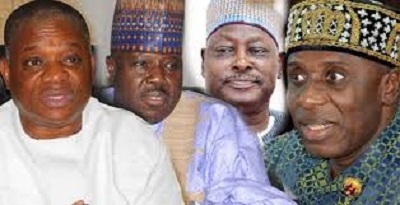
 [dropcap]W[/dropcap]ith the 2023 general election in view, the debate about Igbo presidency has hit full gear. And as far as the ruling All Progressive Congress (APC) is concerned, there are two names that have continued to feature prominently: former Abia State governor, now Senator representing Abia North District, Dr. Orji Uzor Kalu and former Rivers State governor, now Minister of Transportation, Chibuike Rotimi Amaechi. I’m an unwilling participant in this debate because I feel very strongly that the quest for Igbo presidency at this point in time is an unwelcome distraction. I mean, this is a time when Nigeria, beset by mounting economic and security challenges under the weight of which it is looking to collapse, is already becoming a failed state. The debate now ought to be about sitting round the table to discuss the way forward, not about which ethnic group should inherit the mess in 2023.
Having made my stance clear, let me say, regardless, that I feel compelled to contribute to the Igbo presidency debate because it has become imperative to set some records straight in view of unfolding events. Like I noted earlier, Orji Kalu and Amaechi’s names have continued to feature in this debate with respect to who stands a chance in the APC. The former’s quest for presidency has, of course, always been public knowledge. And the latter’s recent affirmation of his Igbo ethnicity has led to many arguing that he is interested in running for president, given the controversy that has always surrounded the Igbo origins of the Ikwere people of Rivers State, to which Amaechi belongs. Some have said he is only claiming Igbo identity because he wants to run for power, and that as far as they are concerned, Igbo presidency should be about the Southeast geopolitical zone, with Kalu often fronted as the ideal candidate. I beg to differ.
To be clear, the idea that Amaechi is ‘claiming Igbo’ because of ‘politics’ and should not thus be considered a potential Igbo president is nonsensical. He is Igbo. He has said time and time again that he is Igbo and even though some of his Ikwere kinsmen now say they are not Igbo, to the extent that Ikwere is now recognized as a separate ethnic group in the Nigerian constitution, it doesn’t change the fact of history and those like Amaechi who chose to remain Igbo must be accepted and accorded all the privileges of being Igbo. Yes, Amaechi has the right to contest for power in 2023 as ‘Igbo president.’ Igbo presidency should not be about Southeast because the zone doesn’t confer or deny ethnicity. Igbo is an ethnic group that cut across geopolitical zones, and if, as both Amaechi and Kalu are the two most prominent Igbo figures in the APC, the choice comes down to both of them, I make bold to say Amaechi will be a much better choice and Ndigbo should back him.
Both men’s pedigrees speak for them, loudly. And Igbo presidency should never be about just any Igbo, it should be about a competent Igbo who has track record. Both Kalu and Amaechi have been governors and their performances in office are there as reference points.
A few days ago, Kalu travelled to Abia in what was his first “official visit” to the state he governed for eight years – from 1999 to 2007 – since he came out of prison where he had been, ironically upon his initial conviction for misappropriation of public funds in those eight years. That ‘triumphant return’ to Abia is evidently a sort of subtle campaign, and it must have amazed many people that despite his record as governor there, there were still people trooping out to welcome him. It is what the elite has reduced the masses to. In that trip, he must have passed through roads riddled with portholes and streets filled with garbage. Those are, of course, the only legacy he left in the state – apart from imposing another of his kind as his successor to continue the legacy of poor governance from which Abia has failed to recover in more than two decades.
Of all Southeast states, Abia has become the butt of jokes and a convenient excuse for those who want to pure invective on Ndigbo. And no other person has more responsibility for this than Kalu. Will he do better as president? Maybe. But we must start from the known to the unknown. And what is known is that he made a mess of his stewardship in Abia.
Amaechi on the other hand, is no saint. But in terms of performance in office as governor, he did much better. This kind of thing must count if Nigeria must get out of the the doldrums it is in presently. Leadership selection must be based on competence and track record, even if it has to be rotated zone by zone or from one ethnic group to the other. To be sure, Amaechi and Kalu cannot be the best the Igbo can offer in this regard. However, my point is that if it comes down to choosing one of the two, the former Rivers governor is, for me, the better choice.
But ultimately, I do not think that a president of Igbo extraction is realisable in 2023, neither am I convinced that it is what the Igbo need at his stage. The solution to Nigeria’s existential crisis is not an Igbo president, it is sitting round a table and renegotiating the terms of the country’s existence. It is evolving common sense systems that have worked elsewhere and shunning the hypocrisy of doing the wrong things for personal or group interest and expecting the right results. It is about allowing merit and competence to take precedence over quota, favouritism and nepotism, and evolving systems that would encourage these.
I do not think that an Igbo president can restructure Nigeria. Such president would be susceptible to blackmail and would have staunch opposition to contend with. At this rate, an Igbo person taking power in 2023 would be offering his head to take the blame for the country’s intractable challenges. It would be an unwelcome distraction. The Igbo must stay focused on the quest for a restructured Nigeria, not for an Igbo president. But like I said, should there be a situation where they have to chose between Amaechi and Kalu, the better choice, obviously, should be Amaechi. The contention about the authenticity of his Igbo origins should never be a factor. The Igbo cannot afford to play until a certain agenda of bringing division among them.