

By: Ike Philip Abiagom, Precious Erugo & Uti Fidelis
 Ugbolu Kingdom, one of the oldest communities in Oshimili North Local Government Area of Delta State, has continued to assert its distinct historical identity amid ongoing debates over its origin and traditional status. The community, which traces its ancestry to the ancient Benin Kingdom, has in recent years intensified calls for greater recognition of its traditional institution and historical heritage.
At the centre of the discourse is Ugbolu’s longstanding quest for autonomy and the preservation of what its leaders describe as verifiable historical records dating back several centuries. Community leaders maintain that Ugbolu has existed as an independent settlement since the 16th century and possesses cultural artifacts, oral traditions, and documented records that support its Benin ancestry.
The agitation for autonomy has generated public discussions, particularly following publications and claims linking the community’s origin to Anam in present-day Anambra State. While some neighbouring communities hold differing historical perspectives, Ugbolu traditional authorities insist that available evidence, including colonial-era court records and ancestral artifacts authenticated by the Benin Royal Palace, supports their position.
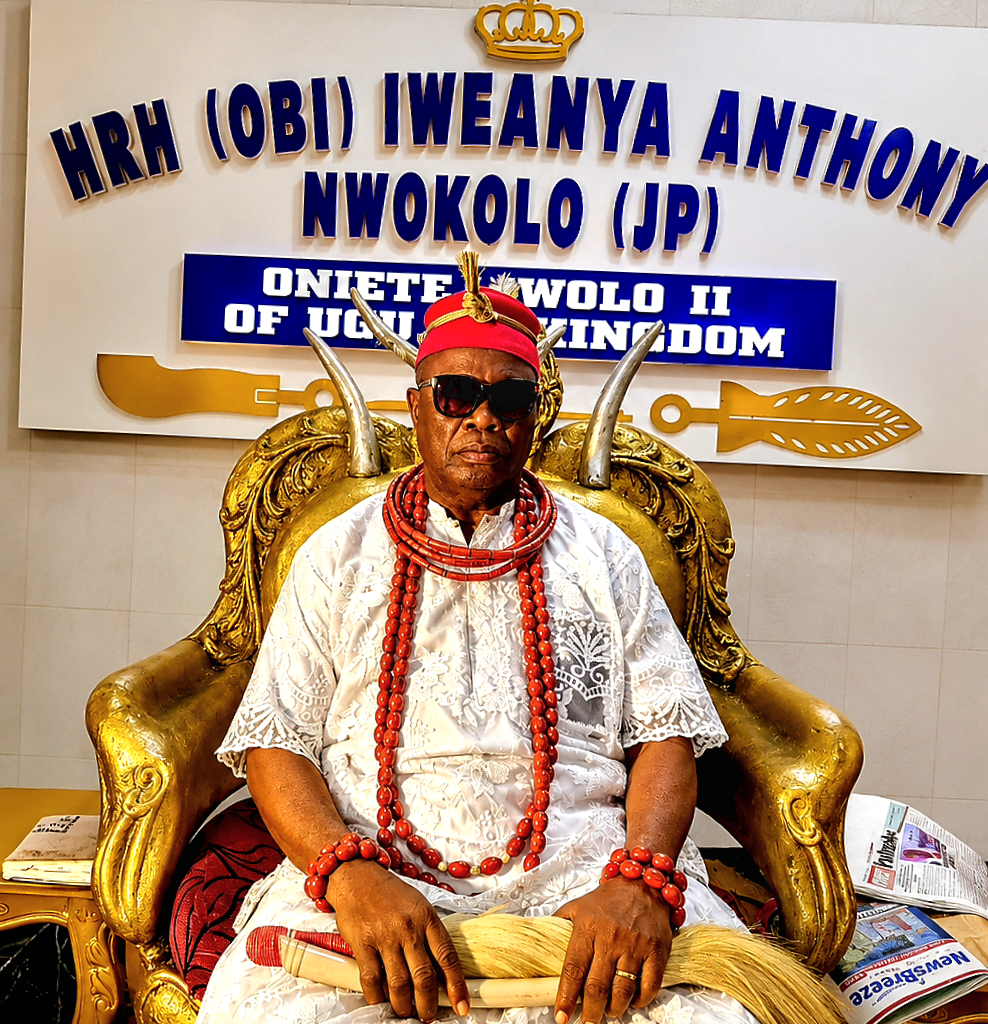
In this exclusive interview with community newspaper publishers, HRM (Obi) Anthony Iweanyi Nwaokolo, JP, speaks on the community’s history, the controversy surrounding its origin, its quest for recognition, and his assessment of the development efforts of the Delta State Government under Governor Sheriff Oborevwori.
Excerpts:
Q: Your Majesty, can you briefly introduce yourself?
A: I am HRM (Obi) Anthony Iweanyi Nwaokolo, JP, of Ugbolu Kingdom in Oshimili North Local Government Area of Delta State.
Q: Your Majesty, what is your reaction to the recent publication in The Pointer newspaper concerning the origin and history of Ugbolu?
A: History is based on facts, and facts cannot be hidden. Ugbolu traces its origin to the ancient Benin Kingdom. Our progenitor, Olu, was a royal prince from Benin who migrated and settled in what is today known as Ugbolu. The historical artifacts he brought with him are still preserved in our kingdom to this day.
I strongly disagree with the claim that Ugbolu people originated from Anam. Historical records clearly contradict that assertion. For example, in 1910, the Odogwu of Ugbolu instituted legal action against some Anam people who were farming in Umuche, Ugbolu. The court ruled in favour of Ugbolu and ordered the Anam settlers to pay an annual tribute of 800 tubers of yam to Ugbolu. That arrangement has continued to this day.
If, as claimed, Ugbolu and Anam are one people, how could a court have ordered Anam people to pay annual tribute to Ugbolu? Such a situation clearly demonstrates that the relationship was not one of common origin but one involving land ownership and customary obligations.
Q: What evidence supports your claim that Ugbolu originated from the Benin Kingdom?
A: The evidence is overwhelming. Some years ago, we took our ancient artifacts, including the Adah, Ebenh and other sacred traditional relics, to Benin for verification. At the time, the late Oba Erediauwa of the Benin Kingdom personally examined them.
I was privileged to present Ugbolu’s historical account before the Oba and his palace chiefs. After examining the artifacts, they expressed surprise at how well they had been preserved over the centuries. We explained that these artifacts are highly revered in our tradition. Whenever they are moved from one location to another, traditional rites, including the slaughtering of goats, are performed as a mark of respect and preservation.
The palace authorities confirmed that such artifacts are unique to the Benin royal heritage and could hardly be found elsewhere outside the Benin Palace. Their conclusion was clear: the artifacts originated from the Benin Kingdom.
That confirmation further strengthens our historical position that Ugbolu is of Benin origin.
Q: There are also claims regarding the historical relationship between Ugbolu and neighbouring communities. What is your position?
A: Historical facts show that some communities migrated from Ugbolu to their present locations over time. Oral traditions indicate that such movements occurred during periods of epidemics and other challenges that prompted people to seek safer settlements.
It is important that history is presented accurately and objectively. We should not distort established facts for personal or political reasons.
Q: Some people argue that Ugbolu traditionally paid homage to neighbouring communities such as Okpanam. Is there any truth in that?
A: No. There was never a period when Ugbolu paid homage or paid royalty to any neighbouring community, including Okpanam.
What existed was a traditional relationship of mutual cooperation. For example, when a community needed an Eze title holder (Red Cap Chief) to perform traditional rites during a coronation, Eze title holders from related communities would sometimes participate in the ceremony.
My father, for instance, participated in the coronation of a traditional Eze title holder in Okpanam in 1975. Likewise, when I took my Eze title, an Eze title holder from Okpanam attended and participated in the ceremony.
Such exchanges were customary and ceremonial; they did not signify political subordination or allegiance.
Q: What message would you like to send to government and the general public regarding this issue?
A: My advice is that government should rely on documented history, verifiable records and traditional evidence when addressing matters relating to Ugbolu.
Ugbolu has existed as a distinct community for over five centuries. Historical records place our settlement in this area as far back as the 16th century. By every standard, we are an indigenous community with a rich cultural heritage and established traditional institutions.
We therefore urge government to continue recognising our historical identity and to give due consideration to our aspirations and traditional status.
Q: How would you assess the performance of Governor Sheriff Oborevwori?
A: Governor Sheriff Oborevwori has performed commendably since assuming office. His administration has demonstrated commitment to infrastructure development and the welfare of the people.
One project that stands out is the road linking our area with neighbouring communities, which has greatly improved accessibility and economic activities. The road serves as an important alternative route for commuters and has enhanced connectivity within the state.
The Governor is known for personally inspecting projects to ensure quality execution. This hands-on approach distinguishes him as a leader who is committed to delivering results.
Q: What additional developments would you like the government to bring to Ugbolu?
A: We appreciate the developments already taking place, but there is still room for more.
We would like to see:
More educational facilities and improved schools.
The upgrading of our health centre into a cottage hospital with resident doctors and adequate medical personnel.
The construction and rehabilitation of internal roads within the community to improve transportation and ease of movement.
Additional infrastructure to accommodate the growing population of the community.
Today, many people are choosing to live in Ugbolu because of its peaceful environment and strategic location. Our modern market has also attracted traders and investors from neighbouring towns.
We therefore appeal for continued government attention to sustain this growth and development.
Q: Any final words?
A: I sincerely thank Governor Sheriff Oborevwori for his efforts in developing Delta State. We pray that God grants him wisdom, strength and good health to continue serving the people effectively.
Our prayer is for peace, progress and sustained development in Ugbolu, Delta State and Nigeria as a whole. May God continue to guide our leaders and bless our communities.